Monday, 15 April 2013

The BIFF BAM POWer monster is very much alive


One of the problems for us ordinary folks is that we can gain so little access to where the power is.  If we did have access then we might very carefully begin to dismantle piece by piece the state which the excesses of the political and power systems of every ilk have brought many of us to, that is : our tolerance and acceptance of the abject poverty suffered by most of our fellows.  It always seems that things are reduced to there being a few winners and a lot of losers.

Looking towards the horizon, change does not seem to be approaching and things will stay as they are if we continue to allow ourselves to be governed on the basis of there being, first: a small group of very powerful, very wealthy winners; second: a greater number – I am ashamed to admit I would place myself in this group  - of those who though they lose most of the time are nevertheless silenced by being allowed the occasional win and so have just sufficient reward to live tolerably while they are  hoodwinked  by an education system which invariably serves the status quo, and,  third : by far the largest group in number, whose members are never allowed to win, can never flourish and who are denied the opportunity of any effective form of expression.


It is evident the powerful few have a hold of both the political system and the media and they use them very effectively as their form of expression. Well, there are the occasional spats, which are sometimes investigated and usually followed by a few show trials of dispensable people. These happen in order to kid us that we really are free but pretty soon things fall back into their old place.   We merely cultivate frustration and despair if we allow ourselves to be duped by the notion that we enjoy freedom of speech or freedom of the press. This has been rather comically demonstrated by the BBC’s censoring Judy Garland’s song, “Ding, dong the wicked witch is dead” following the death of Margaret Thatcher.  This public broadcasting organization, the British Broadcasting Corporation which is supposed to represent the expression of everyone in the UK is so fearful of losing its place close to the vicinity of power, so running scared of being diminished or closed down by a political body which finds the BBC’s notional independence a nuisance, that it kowtows in a subtle but nonetheless cowardly manner to the political and financial power bases. The “Biff, bam, power monster is very much alive.”

This “ding dong” is one of the sideshows which has arisen in the fairground that has been constructed in the aftermath of Margaret Thatcher’s death.  The irony of “the iron lady” is that she is revered mainly by a certain kind of man because she  represented not the “wicked witch” but the Biff Bam Power monster they would have so liked themselves to be.  In this sense Margaret Thatcher was an anachronism. She was a woman who exercised her power in the way all the infamous power mongers  - who were and are overwhelmingly of the male sex - exercised power.  It is a way which says that, “It‘s OK to look after number one at all times and to knock out anyone who tries to get in the way.” It is a philosophy – if it can be called that  - which allows us to understand how the financial crisis of the last decade came about. It shines a light on why powerful and wealthy people invariably look in askance and can’t comprehend when someone suggests that their inordinate affluence and influence could possibly be the cause of the vast amount of poverty so many of their fellow beings are suffering.

People who protest about these matters are frequently described by politicians, and by their buddies in the "free" press as moaning and envious lefties who, when they are not demonstrating or rioting, talk ad infinitum about inequality and poverty, without ever offering up any remedies.  The plight of the protester is not so much what seems the sheer impossibility of persuading the rich and powerful that poor people are fellow members of our human community and we should all help them and support them in getting themselves out of their unhappy and intolerable situation.  It is not so much persuading the powerful to yield up, no, to share their power, to give up much of their wealth and to distribute it fairly.  Of course all this must be done but the real plight for the protester is persuading those of us who  just about get enough out of the financial and political system to keep us silent about the need to start dealing with the issue of  undue inequality in the distribution of the world’s resources.

We should all move towards acknowledging that each one of us owns every single square inch of our planet.  No doubt cynics as well as many of those who consider themselves realists will think these ideas an escape to Planet Krypton but nothing ever gets changed for the better if we don't start trying to achieve it.

We should access and unite our individual power and our different and unique talents to move towards a fairer human community. Let’s change the nature of the Biff Bam power monster. 

Sunday, 17 March 2013

Dennis, the healing tree maker.


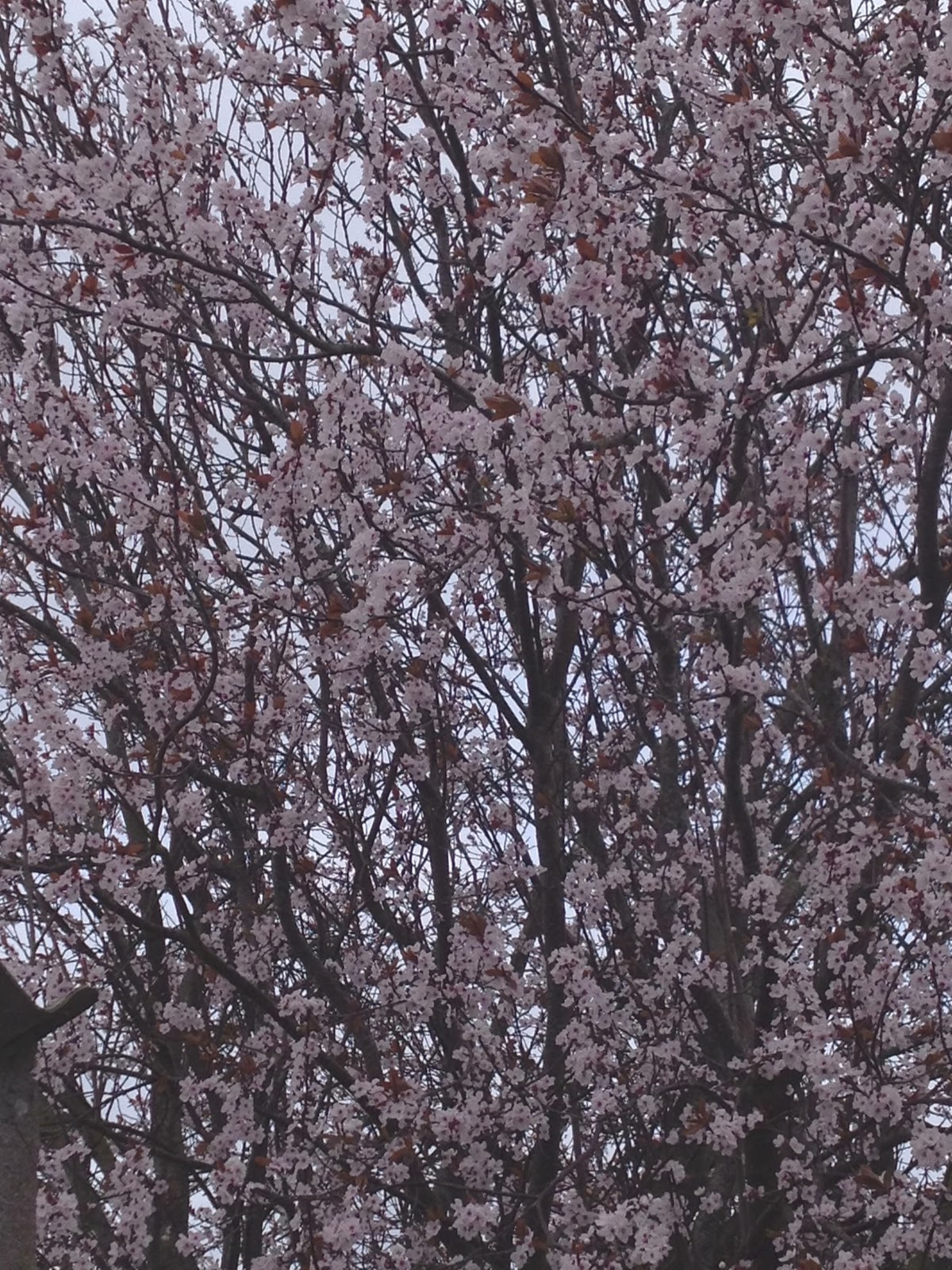
     Every year at about this time, in late February to early March, if you were to walk along the short lane that leads to our house in Totnes you will  see a tree with the most beautiful pink-white blossoms in the back garden of a house.  The man responsible for bringing this tree into life was Dennis who lived in the house with his wife Dorothy until about 20 years ago when they both moved to a nearby residential home for the elderly.


     Dennis and Dorothy have long since passed away but as each year passes I cannot help but compliment the members of the family who now live in the house on the inspiration the blossoming tree in their garden gives me. I know others have said this too. I say Dennis "made” the tree for it was given life because he grafted a cutting from a cherry tree on to the root stock of a plum tree. The newborn tree flourished and now as a mature tree its fruits look at one and the same time like large cherries and small plums and they're delicious to eat. I call it the "Chum Tree."


     As well has having green fingers, Dennis also had healing hands.  

     When he first told me about his healing hands I expressed my scepticism. At the time we were having a beer together in our local, the Bull Inn, and aware of my dismissive attitude to his claim Dennis asked me to let him hold my wrist and as soon as his hands came within six inches of mine I could feel a warm aura from them. He stroked my wrist a few times and although there was nothing wrong with my wrist I found his aura and touch a soothing experience.  

     People from all over the country would visit him at his house to have their aching joints touched by him and as far as I ever heard his patients always left feeling better. Dennis provided this service out of his love for his fellow beings and never asked a penny for it.

     "Any road," (as he, being a Yorkshireman, would say) I hope Dennis would be happy that he is still exercising his gifts through the healing "Chum Tree." 


Wednesday, 6 March 2013

Rest in peace Hugo Chavez : ha tenido coraje


I didn't always agree with your politics Hugo, but I admired the way you used Venezuelan oil wealth to help the poor of your country and the poor of other countries and I also admired how you refused to listen to the overwhelmingly selfish, divisive propaganda that is the mantra of capitalism.


I have no truck with those who might believe I'm simplistic, misled and naive in carrying a torch for you. Here in the United Kingdom I live under (and under is the word) a coalition government  which claims to condemn the wealth of financial tricksters at the same time as saying the very same money cheats should not be stopped from earning even more than they did when their greed was first exposed.


 ¡Viva la revolución


Monday, 4 March 2013

Chris Grayling, beacon of human tenderness and human rights

     Speaking on BBC Radio 5 yesterday morning (3rd March, 2013) the Right Honourable Chris Grayling MP, the UK government's secretary of state for justice stood out as a beacon of human tenderness when he championed the idea of human rights. He did not think that other Europeans were interpreting human rights in the correct way. He suggested that Europeans didn't realise that human rights were something to be cherished and were therefore too precious an entity to waste on those who have got themselves into unfortunate situations,  like prisoners and no doubt those who receive welfare benefits and those filthy poor people who are being moved from the  districts they have lived in for generations because only clean living rich people should be living there. Grasping grandmas have had to be dealt with too. You know, the ones living in council houses who are now, quite sensibly, being evicted from their two bedroomed flats because they have a spare room and have the temerity to think they can occasionally allow their adult children, their grandchildren and friends to stay with them overnight.

     Thankfully, as I write, government legislation has led a number of these latter day upstarts (who at every turn and at any time threaten our rights) to be shifted north to places like Peterborough, Leicester and Bradford where I am relieved to presume lots of poor people live and where these alien and non-alien immigrants who have had the temerity to live in their own community will not stand out as a blot on the Kensington and Chelsea urban landscape.


Thursday, 21 February 2013

Dire and shameful days at Dens Park : my personal apology to Barry Smith

Barry Smith is a good football manager. Without complaining he took on the impossible task of keeping Dundee Football Club in the Scottish Premier League this season. From the start anyone connected to the club  knew  he would struggle against the odds because he was given no time and insufficient resources to prepare a team that would be ready for the task ahead, but then Barry was the man who led our team to a record unbeaten run which (while the club was in administration and with 25 league points deducted) not only kept Dundee FC in the First Division, but also, arguably, kept it in existence. He didn't shrink from what for others would have seemed impossible. He deserved the backing of us all for his courage and at that time he got it. So why not now ?

Not everyone agrees with me and a number of fans on the club's fans' forum regretfully acquiesce with the board's decision, commenting in a tone of,  "You are a legend Barry, but it is time for you to go,"  while an official eulogy Barry - his time in charge  (sanctioned I imagine by the  board) has appeared on the the club website also damning Barry Smith with faint praise. These double-edged remarks and the club's 'obituary' like statement  may act in some superficial way to salve the consciences of those who have made this decision, and those who agree with it,  but in my view it does nothing to put right a wrong action. There was no watertight footballing or moral reason for Barry Smith not to remain as the manager of Dundee Football Club. The decision was precipitate and reeks of panic button pressing when there was nothing to panic about. After all it would be a miracle (a wonderful one)  if the club were to be in the SPL next season. So, now was surely a time to take stock and plan carefully for the future - a future I believe in which Barry Smith should have had a substantive role.

The board of directors of Dundee Football Club have sacked a man of integrity who got performances out of players which often seemed beyond their capabilities. Barry never publicly complained about his lot and he always spoke out in support of his players not as individuals but as a team. In return I believe each member of the team played his heart out for him. I think all the players in his charge have always played for the club in a hard working professional manner.

The current Dundee FC regime was to show a new way of running a football club. A club owned by its fans. A community in which everyone was in it together. Integrity and sincerity would be the order of the day  and all would take responsibility for success and failure.  Now that wonderful ideal is shattered. In the long run the club will suffer for this decision. The spell is broken. It is after all just the same as all the other clubs. We begin to wonder if power is widely shared at this football club or whether it remains in the hands of a few people who whisper together in darkened corners. It appears to have become again an institution which is  happy to defecate on the people who give all of themselves to the cause.  Now we know that  the innocence has been lost, scapegoating and cynicism is back, and the door is left slightly ajar so that one day, at some time, when a seemingly saviour-like person comes along with an amount of money offering to buy us off saying she or he will bring success, we'll go along with it, and so the broken circle continues. If none of these thoughts have any basis then we can begin to imagine that the board of the club would have the courage to rescind its decision about dismissing its manager.

I have been impressed by the CEO Scot Gardiner, (even if he has been a little anal in the way he seems to need to control all the information coming out of the club), almost as much as I have been impressed with Barry Smith. It appeared that he, Gardiner, wanted to run a tidy ship and he gave the impression of being a fan. Just the other week I saw him having a half pint in the Artisan Bar in Abbeyhill in Edinburgh  talking happily with fans after our impressive performance in a 0-0 draw against Hibs. I felt, "Wow, Dundee Football Club really is going to show the football world something different. It has become an open community." That notion is now in tatters.

Barry, I've never met you and I think you are the kind of man who would be embarrassed to be praised,  but, as a Dundee fan for over 60 years please accept my apology that I could do nothing to prevent your dismissal. If you had to go, then in all honour so should every member of the board including the CEO.

Sunday, 3 February 2013

Smack your kids : it's official

Somehow we are not surprised to learn that the United Kingdom government's Minister for Justice, (?!) the Right Honourable Chris Grayling MP,  renowned as the Conservative Party's 'attack dog',* lets us know that smacking children is to be encouraged. After all he was smacked as a child and in turn has apparently smacked his own kids. The implication seems to be that smacking kids does them no harm and indeed is very good for them.

 Supporting Mr Grayling's views on this, Edwina Currie, who in another incarnation was allegedly a government minister for bad eggs, says that everyone knows that a 'light tap' (?!) on the legs has beneficial consequences particularly for toddlers. When asked by a BBC Radio 5 Live presenter if she had ever been physically assaulted by her parents when she was a child, Ms Currie intimated that her parents had never laid a violent hand upon her because she had been a good child.

 This now leaves all parents out there with a problem. How will you decide if the child you are rearing is a good child or a bad child ? If yours is a good'un your tapping hand can stay at rest, but if you've got a bad'un get down to the gym and start working on building up your leg tapping muscles.

To be sure, we are human. We all make mistakes. Sarcasm and pontification are very easy. Many parents smack their children but most of these on reflection would acknowledge that the violence they used was related more to their own frustrations and limitations and was less about the child to whom the smacking was administered. If we can take something from this insight - even if we feel unable to take a moral position on it -  perhaps it is that we can convey the exercise of adults' violence to children towards the state of obsolescence.


*The Daily Telegraph, January 19th, 2009

Friday, 21 December 2012

The Pledge of a Pleasant Person by an ex-Chief Whip

I'd prescribe you a pathologist, patriot, painter, parson, parasite, pauper or more perfidiously a pal; perhaps even peasant, person, pedlar, pirate,  pipsqueak, piper, and patently a pig.

 I'd propose you are a philanderer, philatelist, philosopher, philistine, plasterer, plumber,  plagiarist and plonker too. I'd paint you as a pneumatologist, policeman, politician, postman, and, poodle would do .

I'd present you as prelate, prostitute, and pertinently a prig. I'd portray you a pseudo, psephologist, psycho and/or a psychoanalyst. They'd all do too.

I'd pronounce you publican, puritan, puppet, pygmy and sincerely, though pre-eminently, pyromaniac prorogates my paromoeon web,

For never ever, no never, never ever would I proclaim "You are a Pleb."


Comments


Pierre Pauvre  asks, "Does this mean that hooligan hoodies can now curse and oath willy-nilly at les flics without fear of arrest but if they call them "plebs" they will be sent to Devil's Island ? Sacre Bleu !"


Penny Pincher writes, "Yeah, I was on the Totnes to Paddington train last week and when the guard asked me to show him my ticket, I told him  to  'Pleb off  !!'   I was thrown out of the train at Pewsey."


Paul Pedant, PhD.  states : " It is more aesthetically pleasing to be called a referendum than it is to be called  a plebiscite. Hence the latter is a pejorative term."


Paddy Parboyle rejoins "Even I know the 'p' word is short for "Plebian and I didn't even get an O level."


Petula Partickler points out "Patrick, if that is your full first name, you missed out an 'e' . The word is spelt 'Plebeian."


Noah Pologhi declares "No problems with the 'p' word though it's preposterous that a senior politician who should present as a paragon of parliamentary purity uses profanities towards a policeman without fear of prosecution."


Isa Poplectic concludes, "You can say that again. Last year, at the tender age of 16 and a half years, our Ima was banged up for  28 days in a penitentiary for young persons because he called a policeman "A tall skinny..." and then, " very serious swear word." Where's the justice in that?  but then again, what would have happened if he'd called him by the 'p' word ?  See how the mind can get well and truly boggled ? Any road I think I've finally been able to make some sense of this whole palaver and it looks as how a line can be drawn under it."


Tuesday, 4 December 2012

I'm gonna tell you something you've known all along


     I've always found the line "I'm gonna tell you something you've known all along," from the Blondie song You keep me hangin' on the telephone, uncanny.


     When I'm in a brittle and vituperative mood the irony of the lyrics puts me in mind of a number of academics, though certainly not all, who, after carrying out very important research, tell me all I ought to know about the life I've been leading for 67 years. In this way I interpret the line as "I think you're going to tell me something I've known all along so maybe you shouldn't bother."  This is cruel and mean of me.

     The best way and - I believe -  from the lyricist's point of view,  a faithful way of hearing these words is through the tumult of the idealising,  lustful, and painful love of youth. This meaning urges , 'I hope, no, I'm desperate for you to hear something I'm not sure you knew all along but I desire and demand that you   -  and furthermore I'll die if you don't  -  echo my longing  because I can't bear for a moment longer to pluck rose petals and wonder, "She loves me, she loves me not," '  This is the happiest, silliest, yet most agonising and ecstatic sense of the line. Oh ! for that visceral excitement again.  Well, maybe I'm kidding myself, I'm not sure I could bear it now but the thought and the fancy bring a smile to my face.

     In an ugly and scandalous sense - which I am sure Deborah Harry does not mean to communicate -  the line insists I am fully aware that in the current world set up, and in the current United Kingdom set up, the poor will get poorer, and more miserable, and more hungry, and less healthy, and more marginalised, and more despised, and more misrepresented and less represented and there is nothing I am doing to stop it.

     Shame on me. I need someone to tell me something I've not known all along, who'll let me know how I can help to change the suffering of the majority of my fellow human beings.  Don't keep me hanging on the telephone.

Monday, 22 October 2012

"I'm gonna teach peace to the conquered" : a different kind of helplessness

"I'm gonna teach peace to the conquered, I'm gonna tame the crowd," sings an ironic Bob Dylan in Lonesome Day Blues. When I heard the line I hoped he wasn't referring to the way we sometimes deal with rearing our kids  but one way or another I guess he was, and maybe we ought to hope that ensuing generations will learn from our mistakes but there again the selfish part of human nature so often seems to hold sway.

It may be that the desperate fate of the humble, meek and poor is unavoidable and that they should learn to live with it but that can be tough to take sometimes. You know, like the way the wealthiest and most powerful of succeeding generations try to control and run every aspect of human activity at the same time as telling us, the less rewarded remainder, that the consequences of their exercise of power is for everyone's own good. We should, it seems, be thankful for what's left to us.  Yet forcing something upon people who don't really want it or at least don't really want your kind of peace can never be satisfactory. People may succumb physically to the coercion of the rich and powerful but it usually has a different consequence in the psyche of the subordinated. It can spawn an internal resistance in those not yet  emotionally fatigued by the humiliation of being the bargaining tokens of those who wish to be predominant. This is a resistance that demands a just peace and a fair share of the world's fruit.   Cynics - perhaps even realists - would say that the relentlessness of Dylan's enforcing peacemakers is so overwhelming that in the face of it any resistance dissipates into a despair - a helplessness - that becomes a miserable inertia. Occasionally those with energy left to fight will rebel and make war against injustice but history seems to demonstrate that even the most altruistically motivated of political and economic revolutions end up being contaminated by the self-interest and greed for power exercised by an unscrupulous few and their toadies. Everything seems to fall back into its old perfidious state and the poor remain hungry and helpless.

Be sure this is a helplessness born out of cruelty and avarice.  It is not a magnificent Wordsworthian  moment of helplessness in the face of nature when for a short instance we are filled with joy, awe and wonder that each of us has a part to play, however small, in the great mystery of our universe. No, this is the helplessness which is formed under the shadow of  an abuse of power exercised by a very small minority of humanity against the rest of humanity. What is most upsetting is that many of us enclosed in this selfish process  -  those who are allowed sufficient affluence to make their material life tolerably acceptable  -  acquiesce to the most destructive instances of this malevolent predominance. We are paid just about enough to buy our silence while billions of our fellow beings suffer abject poverty and powerlessness. They starve because the economic and political systems we tolerate allow them nothing.  We pride ourselves on being the most rational and intelligent of species on the planet. Robert Burns remarked that human beings alone have the capacity to reflect on the past, live in the present and  make a reasonable guess about the future. So it is a sad irony that, as Noam Chomsky among others has observed,  humankind is the only species which has taken the trouble to learn how to destroy creatures of its own and other kinds at the same as developing the capacity to obliterate the planet. Yes Robert we may be smart but to date we haven't exercised our smartness too well. It is a pity we haven't had the humility to teach our children about this.

For too short a period of our lives many of us happily immerse ourselves in the joy and  innocence of our children expressed through their curiosity, their imagination, their play as well as their loyalty, love and dependence. How unfortunate it is when the time comes to formally educate them we indoctrinate them to accept  that a measure of material gain makes the blow to their dignity acceptable when  they are asked to doff their caps before the destructive force of the powerful few.

Is there any way we can slowly brick by brick take down the diabolical edifice we have constructed  and carefully build another fairer one ? Twenty years before the French revolution Jean-Jacques Rousseau, in a sense a Bob Dylan of his time, thought such a project possible but only if we were content to live again in small communities where everyone had concern for everyone else.  This was not to be a perfect place - after all  humans beings would inhabit it -  but it would be a place  that could manage without conquerors, a place where peace was natural and where tameness did not have to be inculcated.

My guess is the times are not a-changing that much.


John Stein comments :

We here in the US have a very competitive society and economy.  In competitition, there are winners.  When there are winners, there must be losers.  I think of playoffs in sports. Every team who makes it into the playoffs goes home a loser, except for one.

Our system has gotten out of balance.  We had much better balance a few years ago. Systems that are out of balance, well, eventually they cease to exist if they fail to restore the balance in time.


Thursday, 13 September 2012

Living at ease with my helplessness : part of life's rich pantomime


     As I grow older instances of wisdom occur more rarely than the number of inner conflicts which come to visit and beset me. An internal battle that frequently and readily comes to mind has lined up on one side the forces which tell me what I should and must be doing and invoke the imperative that my inner parent must at all times be assured that I really am trying to be a good boy. Otherwise...... 

     An ally of this force is a compulsion, (dispatched in the form ranting lectures mainly directed towards a televison set), to beseech those groups of people who make up giant institutions  -  like  government and its apparatus, like the media, and like the large financial organisations  -   to listen to the good sense I talk. If they have the nous to act on it they will find, ipso facto, that they have become, each one of them, a good boy just like the one I insist - without cease - that I lives in me or may be the one I think I would like become. Perhaps I'm really giving myself the lecture?

Not a good boy. He has his hands in his pockets


     My failure to be a good boy, as you may have guessed, is due to the regiments lined up in opposition to my inner parent : those parts of me which insist that I will not become the kind of person my “standing on an adult pedestal self " demands of me. These are the impulsions which say, “I do not need to be in a continual state of mental and physical activity. I can put my hands in my pocket! I do not have to be sociable. I can eat and drink what I like. It is not imperative that I struggle against my own primitive desires however aimless or indeed vulnerable they may make me. I don’t need a direction home.”

How is it at my advanced age that I still feel pressed by a need to be in control ? Why can’t I live at ease with my helplessness ?  

“I must try to keep figuring this out.”
 “No I don’t need to.” 
“Yes I do.” 
“No, I dont.......”

Wednesday, 18 July 2012

Father's and Gulliver's Travels : how I came to be special

In the 1950s when we lived in Clement Park my Daddy worked at the Timex factory at Camperdown.
He appeared to us to be a very clever person of some status because he often had to travel on business to Besançon in France where there was also a Timex watchmaking factory, and he regularly flew across the Atlantic to visit the US Time Corporation, which was then the parent organisation of Timex.  The headquarters of  US Time were situated  in Waterbury, Connecticut. His visits there were, as I remember, all to do with his work of designing and producing watches, among which were ones with Mickey Mouse, Cinderella or Hopalong Cassidy on their dials. At the time I think he was engaged in the design and production process of a newly patented watch mechanism called "V- Conic".

Here is an impression of the Hotel Waterbury, where Daddy stayed when he was on the other side of the Atlantic. I've published it because I remember a black and white photographic postcard of this view which he sent to us at home in Dundee.


In those days my younger sister and I thought it quite something to have such an  exotic father : one who travelled to these faraway places. I didn't know anyone else who had been abroad, only my Uncle Jim who had been wounded in 1940 during the second world war by shots fired from a Stuka dive bomber on the beach at Dunkirk. Thinking back now it strikes me as strange that I never thought to rank on my very short list of people who had been abroad my Mummy's three brothers who were all seamen in the merchant navy which was the career of choice for many young men from Dundee in the 1930s, 40s and 50s. That's a story for another time.

When he was working in Dundee we seldom saw Daddy during the week except briefly at breakfast and for a short period before we went to bed. He arrived home from work about half past six. We'd have our tea with him before we ascended the stairs to bed at about a quarter past seven.

We saw more of him at weekends when he would drive us to Broughty Ferry or as far as Glen Clova for our Sunday picnics but most of the time our lives revolved around our Mummy and particularly so when Daddy was in America or Europe. Our  weekly family Sunday sojourns to Arbroath did not really begin until my youngest sister was born in 1955. Another tale waiting to be told.

Daddy did seem distant and not only when he was away from home. Mummy - except when she was crabbit with him - gave us the impression that he was very important and successful and so it came as a surprise to us when one evening -  I was about 9 at the time  and my sister was about 8 -  Daddy, returning from work, announced that he would be reading to us each night. After tea he sat in his armchair in the living room and we sat on the floor looking up at him and listening to him as he read to us for about 15 minutes from Jonathan Swift's Gulliver's Travels. He did not read from an edition adapted for children but from a big old dusty volume with the original text of the 18th century political satire. As I recall he read to us every night for about a fortnight until he had to leave us yet again to work in the USA for a few months. The ritual of the reading ended and was never to be repeated. This didn't matter. His job was already done.

My sister and I had not understood a word of what Daddy read to us, 18th century syntax was a mystery to us but we sat there still, intent and silent every evening listening in awe to my Daddy''s voice and feeling very esteemed that our father, this distant yet important man had read to us. It may not have been the most warm expression of love but it was a precious gift which I've carried with me throughout my life. If this father, our Daddy had taken time to read to us then we must be very special children indeed. 

Tuesday, 26 June 2012

A reverie on time, death and faith : what Robert Burns and the summer solstice brought to mind


On the summer solstice it seems we deny our nemesis when we call it "the longest day of the year." This mathematically and linguistically confusing declaration implies that we can stretch time. However absurd a suggestion it may be, it remains a notion set to please an optimistic imagination.

So it is sad human are  governed by their capacity and need to be rational - even though they can never sustain rationality  -  that they cannot allow fancy to reign and so be imprisoned by time. I suppose this is what Robert Burns was saying to "the wee sleekit, cowerin', tim'rous beastie" when he declared “moosie thou art  blest compared wi’ me, the present only touches thee.” For the poet’s wee moose time has no meaning, but human beings not only look back "on prospects drear," but are also impelled, even if they can't see the future, to exercise their facility to imagine what lies ahead for them as well as knowing and often dreading the inevitability of  they fate.

Some human beings can however feel “blest” in other ways and through their religious faith can sustain the notion that time can be conquered. Those who have such beliefs tell us time and death holds no fear if they have led a good life and have kept their faith. They are comforted by the certainty of their eternal souls.

In some ways I regret I cannot sustain the idea of such a triumph over time and death.  For me, limited –  or trapped, as those with religious beliefs might claim  -  by what I understand to be my finite nature,  faith in eternal life can appear but a sad, and tragi-comic quixotic gesture ;  a futile railing against a certainty.  It may be courageous to declare, " Now you listen to me TIME, you may frighten others but I've learned to believe in a future upon which you have no influence."  For me this is a flimsy bravado all too easily swept away by Marvell's "winged chariot hurrying by."

In my reverie over these matters a short title for an essay comes to mind, : "Is time a good thing? : discuss."
Another might be, " Is death a good thing?"  and a third, “Is faith a good thing ?” I need to think about these matters further. I wonder if I will have the time. 


Comments

John Stein observes " I too, am fascinated by time and by the inability of many to grasp its immensity.  Perhaps that's the wrong word.  It seems our perspective is limited to about 100 years--roughly our lifetimes or perhaps our hoped for lifetimes, or maybe a couple or three thousand years, back to Biblical times.  We can't quite grasp a milllion years, let alone 4.5 billion, the age of the earth, or even
more--the age of the universe.  We envision a heaven where our loved ones are looking down on us, even though we've been up there and seen no signs of it.  We've been pretty deep in the earth and have seen no sign of hell, either..."

Alex Russon writes "I'm fascinated by 'time' too, particularly when related to pre-destination. If our time on earth is pre-destined, why put the effort in? Should we just mark time for three score years and ten then shuffle off again? But I have a belief in a God whose power is beyond our understanding and who has sovereignty over even 'time' itself, this means I can use the brain I was born with to make decisions after all rather than be a puppet on his string. I believe in eternal life. We have a very short period here on earth to make the most of before an eternal life in heaven or elsewhere, for my part I plan to spend as much of it on the golf course as possible!"

Friday, 18 May 2012

The road and the miles fae Forfar to Dundee : August 1950


I was born in Dundee in 1945. We lived for a few months in an old tenement near the new housing development Fleming Gardens while we waited for my Daddy to be demobbed from the Royal Navy.  Soon after this we moved to Forfar where Daddy had got a job as an engineer at Dons Brothers' Jute Mill.

For the next 5 years we stayed at 9 Green Street which was off the High Street. Green Street led down to the Greens. They were called the Greens because they were the communal washing greens where people who lived nearby could hang out their washing   It was also where the tinkies - who I once tried to run off with -  would congregate and stay for a while with their ponies, carts and caravans, but that's a story for another time. It's a car park now though the wee burn I used to try to jump over and most times fall in, still runs through it and I think it still feeds the remains of a square concrete children's paddling pool where my younger sister  - who'd decided to make her appearance in 1946 -  and I played as toddlers.

Number 9 Green Street was a wee privately rented "but and ben" cottage which has since been re-developed (though I am always comforted when I return to Forfar to see that Green Street and the rest of the centre of the town look very much as I remember them when I was a bairn in the late 1940s). Our house consisted of two rooms. One was my parents' bedroom and the other was a communal room which was  at one and the same time the kitchen and living room as well as having a curtained off alcove where my sister and I slept. The lavatory was situated off a tiny passage that led to the back door.  We got our water from a well in the back garden.  We had no electricity, so we had a gaslight and our radio (or "bandie" as we called it) was powered by large clear and heavy bakelite batteries which seemed to be filled with a blue liquid. The bandie had other fascinating things inside it that my Daddy called valves. These would best be described now as looking like funny shaped clear glass electric light bulbs (the kind of light bulb which is itself now defunct).

One day in August 1950 we moved back to Dundee.  My Daddy had got a job at the Timex watch factory at Camperdown. At the same time we had been provided with a council house in Clement Park in Lochee, once a small town in its own right but by this time engulfed by the greater Dundee urban connurbation.

On the day we flitted,  Mummy, my sister and I sat in the front of the removal van. Daddy was at work. As we set off on the 15 miles to Dundee it was decided that I was to sit next to the driver.  Nowadays the road to Dundee from Forfar is a dual carriageway. In those days it was a winding and twisting road until you got to the long straight which passed by  - as I remember it -  Tarbrax and Tealing.   About 5 miles into the journey there were a series of hairpin bends at Toddhills. As a boy every time we subsequently made this journey to and fro  on our visits to Grannie and Grandad Sharpe who lived in Forfar,  I found Toddhills  the scariest part of the road for the land on the left hand side seemed to fall away steeply into a ravine. I knew we'd got through the scary part when we'd reached a junction where if you turned right you headed towards Glamis and Kirriemuir and if you went left continuing on the main road you headed on to Dundee.  On the day of our flitting to Dundee it was just after this point of our journey that I built up the courage to talk to the driver of our removal van. There were things I thought he needed to know.

"We're moving to a council house. It has an upstairs as well as downstairs. It has things called switches on the wall and if you touch them  lights come on and in the kitchen there are two wells. One has cold water and the other has hot water. I didn't mention that there was a room on the upstairs with a bath in it that also had  hot and cold wells. At that early age, and for some time to come, having a bath held little appeal for me. In Green Street my Mummy had struggled to get me into the zinc bath she filled with water for me and I was only persuaded to get in it when she threatened to tell Daddy how naughty I had been when he came home from work. This threat modified my behaviour throughout my boyhood but I have no recollection of my Daddy ever punishing me following such an ultimatum. I continued my information sharing with our driver thus, "There are plugs in the wall and we will have a new bandie and it will not need batteries because it will be plugged into the wall but Daddy says we are not allowed to touch the plugs".

Once I'd finished my lecture about my new house, the driver  - who I now understand not to have been a country town Forfar loon, but a streetwise big city Dundonian -  didn't seem to share my excitement about my new project. His response to my tutorial was,  "Eh, that'll be right".

About 12 miles into our journey, at the end of the long straight we saw to our left the ruins of Powrie Castle, and at the top of Powrie Brae, where the Black Watch memorial now stands, the road turned a sharp right and then descended to a winding left hand turn where suddenly we saw the steeples and chimney stacks of the city and there in the distance briefly curving out across the Tay estuary before it straightened towards Fife was the Tay Rail Bridge. I didn't know then that in less than 10 years time I would cross that bridge and leave Dundee and Scotland for what has seemed forever.


Wednesday, 11th April, 2012