Saturday, 11 October 2014

A letter from America : there's aye hope

I wrote this blog about 24 hours after the results of the 2014 Scottish Independence referendum had been announced. I couldn't post the blog then, my feelings were too extreme.  To say I was "gutted" about the result doesn't express the half of it. I've severely edited what I originally wrote because it may have upset some people, but here is what is left of it. The extreme passions my words imply have assuaged but I will not lose touch with my underlying desire and belief. 


A friend who for a while has been living out in Chicago, Illinois, recently sent me an email saying that she was surprised to find how many citizens of the Land of the Free thought that Scotland was already an independent country. If only it were so. It was because Scots people were not free on the land that they worked and which should have been theirs that so many of them were forced to leave for  North America in the first place.


The railtrack from Miami to Canada : New Orleans to Chicago


And now that Scotland has had its referendum and the majority have voted for Scotland, a) to remain in the union, b) to support nuclear warfare, c) to take part in the bombing, killing and terrorising of innocent families in the middle east, knowing full well that there is no likelihood that they will ever be in a position to send aeroplanes and troops to bomb and slay us, d) to allow its national health service to be privatised so that poor people can't afford it, e) to accept that the working conditions ordinary trade unionists have struggled over 100 years for are now turned in a period of less than five years into zero hour contracts and fake jobs, where do we go from here ?

I may have been reeled dizzy by the result of the referendum, but in the occasional instant of stillness  I am left to wonder what the result might have been if the referendum had been a fair contest. For instance how would things have turned out if the BBC had fulfilled its responsibility to be neutral. I try - even if I fail  on some occasions -  not to make extreme judgments on anyone or anything in this blog but on this occasion moderate expression won't surface. I have trusted and relied upon the BBC a great deal for what it provides on the television screen, on the radio and on its website. I have particularly enjoyed its sports coverage on Radio 5 live but its reporting throughout the Scottish referendum campaign has left me distraught. During this time the BBC acted as Westminster's propaganda machine. As if the YES campaign had need of any other obstacles placed in its way, what with the continuous blasts of shelling from the howitzers of the entire British and Scottish mass media outlets (with the exception of the Sunday Herald) directed upon it. OK, to an extent we can accept that  privately owned mass media outlets, are free to peddle prejudice as if it were news,  but the BBC....  Oh! dearie me.  I do hope the BBC reflects upon its unfortunate and lamentable reporting of this the most important event in Scottish history for over 300 years and that it will now work hard to take the long steep climb back to what used to be its exceptional standards.


BBC public service broadcaster or Westminster propaganda machine ?


I'm too emotionally knackered to write at length about Gordon Brown strutting around like a goose shouting out that the Labour Party would never privatise the National Health Service when it was he and his predecessor Tony Blair who ushered in the the privatisation of the NHS. He has told us that we should believe the promises the three stooges from Westminster gave when they made their farcical appearance in Scotland a couple of days before the vote and vowed to give Scotland winning lottery tickets in perpetuity if it voted "No".  What's sad is that a part of the Scottish communal psyche was taken in by them !

Nevertheless it has been pleasing to hear that people from all over the world are congratulating the Scots for carrying out the referendum so peacefully. There have been a few skirmishes around the fringes but certainly when I was in Scotland over August I did not experience any worrying incidents even though the discreet yet visible badge I was proudly wearing had a clearly printed YES on it.

Since the result of the vote was announced many of my English friends and acquaintances have sympathised with me knowing that I had supported the defeated side. A number have said that they are pleased that Scotland has voted to remain within the union but, at the same time, they believe that the referendum is stirring up England. People in the regions of England are beginning to say, "We want more control of our communities".


Once I'd  got up from my bed on the morning of September 19th, I was elated to find that the people of the City of Dundee, the city where I was born, where. over centuries, courage, love,  imagination, hard work and creativity in the face of all kinds of adversity have always been the order of the day,  had voted more emphatically for independence than any other place in Scotland !

The vote in Dundee, as well as in those other regions which voted YES reminds me that there's aye hope.  Let's put right our sense of timing, let's not wait too long, let's not get things wrong : Lochaber again, Sutherland again, Skye again, Lewis once again, Bathgate once more, Irvine once more, Linwood once more and Methil just once more.


The Auld Steeple, a symbol of Dundee's courage and steadfastness


With acknowledgement and respect to The Proclaimers,,1987. https://www.youtube.com/watch?v=yy9GmieAEaQ
"


Saturday, 27 September 2014

“No strangers : ancient wisdom in the modern world”


     An exhibition of photographs about the daily lives, experiences, culture and plight of indigenous people throughout the world was held at the Royal Botanic Garden, Edinburgh earlier this year.

     For me it was a moving and humbling exhibition and my attention was arrested by its introductory text which was mounted on a board at the entrance. I asked at the Botanic Garden’s reception desk if there were copies of the text. Alas there were none so I borrowed pen and paper and with the help of my wife copied the text (as we saw a number of other visitors do). I have posted it below.

     I believe the author of the text is Wade Davis, a Canadian  anthropologist and writer, who curated the exhibition.

     The words leave me with questions about how different human communities relate to each other. I think they offer possible directions for thought about how we exercise our respect for others and how we may help our children respect and care for people from communities different from their own. I believe many of my generation  have singularly failed, and continue to fail,  to do this.

     Here is the text. 


No strangers : ancient wisdom in a modern world

     Over the last decade science has revealed how closely people around the world are connected. We are all brothers and sisters. We are all descendants of common ancestors who  walked out of Africa some 60,000 years ago. Their epic journey continued over 2500 generations, carrying the human spirit to every habitable corner of the world.
     If all of humanity emerged from the same fountain of life, all cultures share the same raw genius, how this intellectual potential is expressed is simply a matter of choice and circumstance.
Traditional societies are not failed attempts to be modern, let alone failed attempts to be like us. Every culture is a unique expression of human imagination and heart. When asked what it means to be human and alive, the peoples of the world respond in 7000 different voices, 7000 languages that together express the full wisdom and knowledge of our species, insights that no doubt will prove invaluable to future generations, even as we continue this never ending journey.


To discover  more about Wade Davis visit 

Sunday, 21 September 2014

A young woman asks Alasdair Gray about his novel "Lanark" : the trauchle of supporting Dundee FC and other major causes


When the outcome of a major or minor event is something that doesn't please you, for example, like  the result of a football match today at Dens Park,  Dundee 1 Dundee United 4,  it is tempting to analyse and rationalise it until the will to live is lost.  It can be a right trauchle. It exhausts the mental substance.  Having attended an event at the Edinburgh Book Festival in Charlotte Square this August past, I have moved towards persuading myself that I am cured of this affliction.

After giving some readings at the festival from Of Me and Others : An Autobiography, a book he says is the nearest he'll ever get to writing an autobiography,  the Scottish literary and artistic phenomenon that is Alasdair Gray was told by a 16 years old voter and school student in the audience that she and her fellow students had been asked to read and study his novel, Lanark for their Scottish Highers examination at school. She wondered what he thought about that.


Alasdair Gray said that he had been shocked to hear that school students should be asked to study his books. He feared that if children had to study them in an academic and analytic way as they did Shakespeare they would come to hate him just as they hated Shakespeare. Before you start throwing literary bricks at me, I hasten to add that I gained the impression he was making a statement about the way literature is taught rather than denying the merits of the English bard. He said that he just wanted people to read his books and enjoy them  -  nothing more.


He asked his questioner if she had enjoyed his book.  She said she had. That pleased him.


From this, for the time being, I have concluded that you either like a book or you don't like a book. If you fail to find favour in one, before wasting any time on reflection,  move on swiftly and read another in the hope that it will be better. This may also be true for other events in life.


I'll be picking up my next book soon. Dundee play Dundee United in the Scottish League Cup at Tannadice  on Wednesday night.

Wednesday, 17 September 2014

My last campaign

I have marked the Scottish referendum on September 18th, 2014 as the site of my last political campaign. To be truthful I have seldom been on a campaign trail ; canvassing at people's front doors ; handing out leaflets or making sure that elderly voters are able to get to the polling station. Political campaigning is not strongly represented in my genetic make up. My Dad, I think had Conservative tendencies but did not always make it to the polling booth. I think my Mum followed my Dad's voting intentions focussing her efforts on sovereignty within her family. Grandad Jackson had Labour sympathies and Grandad Sharpe was sympathetic to home rule for Scotland, but politics were not often discussed in our family and my parents always insisted that voting was a secret process not to be shared with others.  We do have an outstanding political campaign organiser in our family and that's my son. I am so proud of him but I can take no credit for his political brilliance.


Home rule for Scotland : my younger sister and me somewhere in the Trossachs, 1956


My political campaigns have mainly taken place in my head as I composed acerbic sentences about the opponents of the party with which I sympathised but very few people ever got to hear these.  Add to that conversations with family members and friends; the odd sarcastic comment in the Bull Inn, Totnes towards fellow customers who in my almighty view have made a  particularly distasteful or reactionary remark ; the inevitable verbal tirade directed at the television during news bulletins, and there you have the meagre sum total of my campaigning.

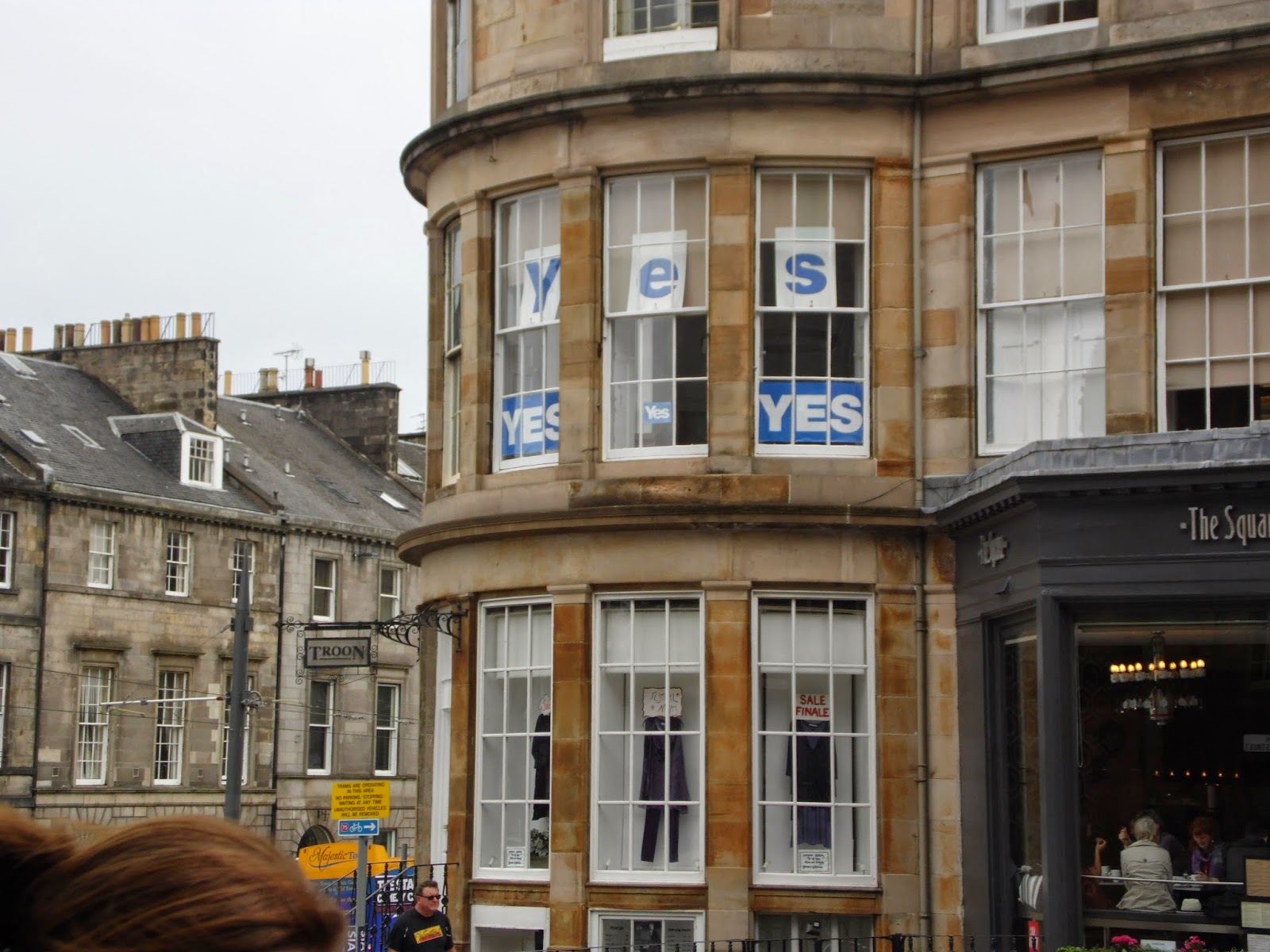
An exception has been the current Scottish referendum campaign. I have been more actively involved in this campaign than any other. My wife and I spent the month of August in Edinburgh and the atmosphere was such that you could not fail to be drawn into the referendum campaign on one side or another. We both support the YES campaign and we spent the month attending talks, public meetings and holding informal discussions arguing the case for independence. We wore and are still wearing our YES badges with pride. We put up YES posters on the windows where we had authority to do so. On returning to Totnes I have been trying to persuade Devonians that an independent Scotland would be a good thing for every country in the British Isles. It might persuade them to bring their governance closer to the heart of their own communities rather than allowing it to be housed in distant Westminster.

 I have also been sending encouraging emails to  friends in Scotland who are working tirelessly for the YES campaign, urging them to keep going and thanking them for their efforts on behalf of an independent Scotland. As readers of this blog know I have also been writing in support of the YES campaign.


Let's hear it for the YES campaigners

My efforts are minimal when compared to the people working for the YES campaign in Scotland. The YES workers have been heroic in bringing the campaign to the stage where victory is possible. The entire forces of the national media have been blasting against them, including the notionally balanced and unbiased BBC and you can add to that the propaganda machines of Westminster's main parties. So let's hear it for the YES campaign workers. The highest recorded figure of  97% of the Scottish electorate have  registered to vote in the referendum, ensuring that those who previously may never have valued themselves enough to vote because of the way the political and economic system has been stacked against them, have a real opportunity to change the course of Scottish history. Referendum day will be their day. The vision, enthusiasm and determination of the YES campaign has largely been responsible for this. Even those intending to vote against them will in all fairness admit that YES workers have run a great campaign.


My shameful political history

My family, friends and colleagues may be surprised and disappointed to know that I have in my time voted, in both general and local elections, for the Conservatives, the Liberals, Liberal Democrats, Labour, the Scottish National Party, the Green Party and I recently I deliberately spoilt my vote. Before castigating me for chronic disloyalty I would argue, but will not do so here, that there is a natural, as well as considered stream of thought running through my voting pattern. I believe it is more important for a political party to listen and show loyalty to the developing ideas of all of its supporters rather than the supporters being subservient to their leaders' personal ambitions for power.

Most of my votes have been cast in England, which for the majority of my life has been my primary place of residence.  My first vote however, was cast at the polling station in Johnshaven, a fishing village in what was then Kincardineshire. I was almost 24 years old. In those days you had to be 21 years old to vote and the previous general election had been in 1966 when I was only just too young to vote. In 1970 I voted Conservative because I admired Ted Heath's long held determination to make the United Kingdom a member of what was then the EEC and is now the EU. I am encouraged that those who are leading the current campaign for Scottish independence desire that Scotland should play a full part in Europe, something political leaders south of the border are increasingly less enthusiastic about.

In that 1970 election, Alick Buchanan Smith,  the standing MP for North Angus and the Mearns was duly re-elected with a large and increased majority. The Labour candidate was a distant second. Overall in the United Kingdom the Conservatives gained a House of Commons majority and Ted Heath formed a government.


In 1973 following Margo Macdonald's stunning by-election victory in Govan while she was standing for the SNP,  it began to seem possible that the Scottish electorate might vote for independence. The romance of that idea, so close as it was to my natural sympathies, impelled me in the 1974 and 1975 general elections to vote for the SNP candidate even though I was in a place of work where the support of conservatism with or without a capital C was demanded. I did not shout out my affinity with the independence cause, and, in a way I can't be proud of, I gave out the impression that I would join the crowd and vote Conservative.  I can only say I was a young man with a young family and my wife and I had to earn the money to feed, clothe and shelter our children.  I guess I am mentioning all this to show that despite errors of judgment, mistakes and subterfuge I have always hoped for an independent Scotland.

For the record Alick Buchanan Smith won the 1974 and 1975 elections but the SNP came second in both and the Tory majority was reduced to under 2,000. I like to think that my votes formed a tiny part of a small step on the stairs that have led us to the vote tomorrow.


The source of my desire for Scottish independence

1975 was my last opportunity to vote in Scotland. Why then, when I will have no vote in the referendum and having spent 50 years of my life here in England - this present tour has lasted 40 years  -  do I still carry a torch for an independent Scotland ?

That's a difficult one to answer. I don't believe that the decisions we make are ruled either by the heart or by the head. I am sure they are formed by a combination of both. In my case the balance may fall more on the heart's side for I know that many of my sympathies lie deep in my childhood experiences.

During my first primary school years, in the early 1950s I was impressed, proud and entranced by the courageous deeds of the Scottish heroes my teachers at Liff Road School, Miss Wilson and Miss Gilchrist described as they told us about the struggles William Wallace and Robert the Bruce faced in trying to gain independence from Scotland. I was entranced to the extent that when, at about the age of eight, I was asked in my English lesson to write a poem, I took out my pencil opened my exercise book and began to scribble a poem about making Scotland free. Its opening lines were this couplet :

Come on you Scots don't be like cattle
Draw out your swords and charge into battle!

This is all I remember of the poem.  When I showed the poem to my mother she liked it but my father, a mainly dour engineer did not : more of that on another occasion. You'll agree the couplet does not indicate the first flowering of a poetic genius. I'm still fond of it though because it is the earliest signal in my memory which marks me out as someone who wanted independence for Scotland. Though other thoughts and priorities may at times have got in the way I have never lost this deep-felt desire. My view on Scottish independence has never changed. Of course, in other pieces of writing I have offered up what might be described as more sophisticated reasons for supporting Scottish independence, but my political star on that issue was fixed at the moment before I'd set the pencil to my exercise book.

For me the referendum being held tomorrow on September 18th, 2014 is a now or never event. A lifetime's desire will be satisfied or it will be thwarted. If the people of Scotland do not vote YES then I cannot see another opportunity to seek independence arising in the years remaining to me. Whatever way it goes, this is my last campaign.


Comment

Jan Noble writes

Hi Charles

I have followed your blog for a long time. I’ve enjoyed it, laughed at and with it, been moved and stirred up by it at times but I’ve always kept quiet. I’ve never been a 'letters to the editor’ sort but I thought I should respond today. No, I’m not a gloating Englishman nor is this sporting applause as brave Scotland walks defeated back to the pavilion. I think all I want to say was how important your blog is and has been in the last few months leading up to the independence referendum. 

Personally I am glad of the result. And although my girlfriend, an Italian, informs me that last night she dreamt I leapt ecstatically from a tower block draped in a union jack ironically shouting “Yes” when the “No” vote was announced, I can assure you this says much about the Italians and nothing about myself or my views. The thing is I was not drawn into the debate but rather put off by it and the grey suited arguments presented by both camps. Your blog however was a voice I heard and listened to throughout. More personal than political and without tactical canvassing you expressed your opinions, thoughts and feelings and won my ear. I was swayed. I became sympathetic to a Yes vote and I’d say, in this sense, result aside, your campaign was a success. 

The argument is not lost. It continues. I look forward to your future posts. 

Keep writing!

Jan

PS I can still sing the words to Scotland's 1978 World Cup song - the first football song I ever learnt. I hope you can take this as some consolation.

Find out what Jan is currently writing and performing at jannoble.co.uk


Sunday, 14 September 2014

Culture or country ? a few thoughts from James Kelman on Scottish independence

     I know that I write these blogs to release emotions and thoughts which seem too powerful for me to contain inside my physical frame. It is a surprise – a pleasant one, I would add  -  to find that people read them. I guess that many visits to Leaving Dundee are fleeting ones : people researching particular topics and finding that my reference to them is not what they were looking for. For others perhaps my blogs offer a way towards thinking about their own past experiences and making their own reflections upon them. That would make me feel good but I may be flattering myself with that fancy. I don’t know. All I would say is more people read my recollections of a Dundee childhood than my political polemic. Now don’t get me wrong, Leaving Dundee is no big deal. None of these blogs ever “trend” but, for the information of the select few who, I am grateful to say, do visit, more of my Dundee childhood recollections will be appearing on the blog in the coming months.

     For the moment politics fill my cosmos and there are no prizes for guessing why though I don’t think my politics can be separated out from my past experiences since the latter have created who I am now. This leads me to say that my desire for an independent Scotland is a long standing one and goes back well over 60 years to when I was a boy of 7 or 8 who couldn’t fathom out why  -  given the stories my teachers told me of the heroism of William Wallace and Robert the Bruce  -  my family was ruled by people mainly from another country. It made me feel that I was deficient in self-worth. I will write about that in a future blog.

     That was all a long winded way of saying my wish for independence comes from a strong feeling that I deserve to be  valued as much as, but not more than, the next person and what follows this meandering preamble is an extract from the text of a talk about self-worth entitled  “Independence is not an economic decision, it concerns self respect.”  The talk, was delivered over two years ago by the internationally celebrated novelist James Kelman at a time when a public debate about Scottish independence was being called for . The full text can be found at the National Collective , a website that provides a place of expression for Scottish creative artists who support independence.    


James Kelman


     In this talk James Kelman shows himself to be more interested in the distinctiveness of a culture rather than of a country. When I came upon it this was the aspect of the talk which captured my thoughts for he was suggesting that independence does not appeal to Scots who are on the make, but does appeal to people who want to make, and have, a reasonable living only if everyone else in their community is sharing that experience. Certainly that is how I have interpreted Kelman’s idea of culture. For him the desire for an independent Scotland is not a nationalistic one but is a desire for self respect.

     Taking that as a point of departure,  my own position is that a community populated by individuals who have self respect, and consequently a respect for others, will be a good community well able to confront its difficulties free from the deceit which is evident in the governance of today’s United Kingdom.

     So here at last with a characteristically only just contained vituperative tone, yet bearing a clear and compelling message, are the words from James Kelman’s talk.


“ Scotland does have a history, I’m not sure where it belongs, in the history of servitude, subjection, psychotic inferiorisation, god knows, these different ways people avoid responsibility. We need a proper debate and it’s up to us that it should go that way. How many of us never mind the rest of Britain know that those in favour of independence are not necessarily nationalist? It’s said of me. Let me repeat I am not a nationalist but I favour independence 100%. I was on a platform with four other Scottish writers in France recently. Each of us favours independence, and none of us is a Nationalist, as far as I know.
“Independence is not an economic decision, it concerns self-respect. How many countries do we know in the world where the people need a debate about whether or not they should determine their own existence? Ultimately it concerns survival. For whatever value our culture has it is ours, and like Sorley MacLean once said about the Gaelic language, even if it was a poor thing, it would still be loved, and those who used it would still have the desire to see it flourish. We may distinguish between country and culture: I favour ‘culture’. It may be the point where a clear separation occurs between nationalists and others.”